Designing trading intelligence for the moment a decision still matters
Active traders process chart patterns, market signals, news, risk, strategy rules, and their own performance history while the useful decision window is closing. I designed TraderVault LM to reduce that cognitive load — surfacing the relevant setup, context, and risk before the moment passes.

The decision-support environment — the setup, the reason, the risk, and the relevant history, brought forward before the moment passes.
More data never improved the judgment
Traders have access to more information than they can reasonably process in real time.
I kept running into the same shape of failure: tools display more data without improving judgment, and the pattern becomes obvious only after the setup has passed. Strategy testing, live signals, risk, execution, and journaling live in disconnected places — and the journal, the one record that could teach the trader something, usually becomes an archive instead of a feedback system.
No one can watch every relevant signal at once.
Patterns become obvious only after the setup has passed.
Strategy testing, live signals, risk, execution, and journaling are disconnected.
Trading journals become archives instead of feedback systems.
And underneath all of it: automation can easily imply certainty where none exists.
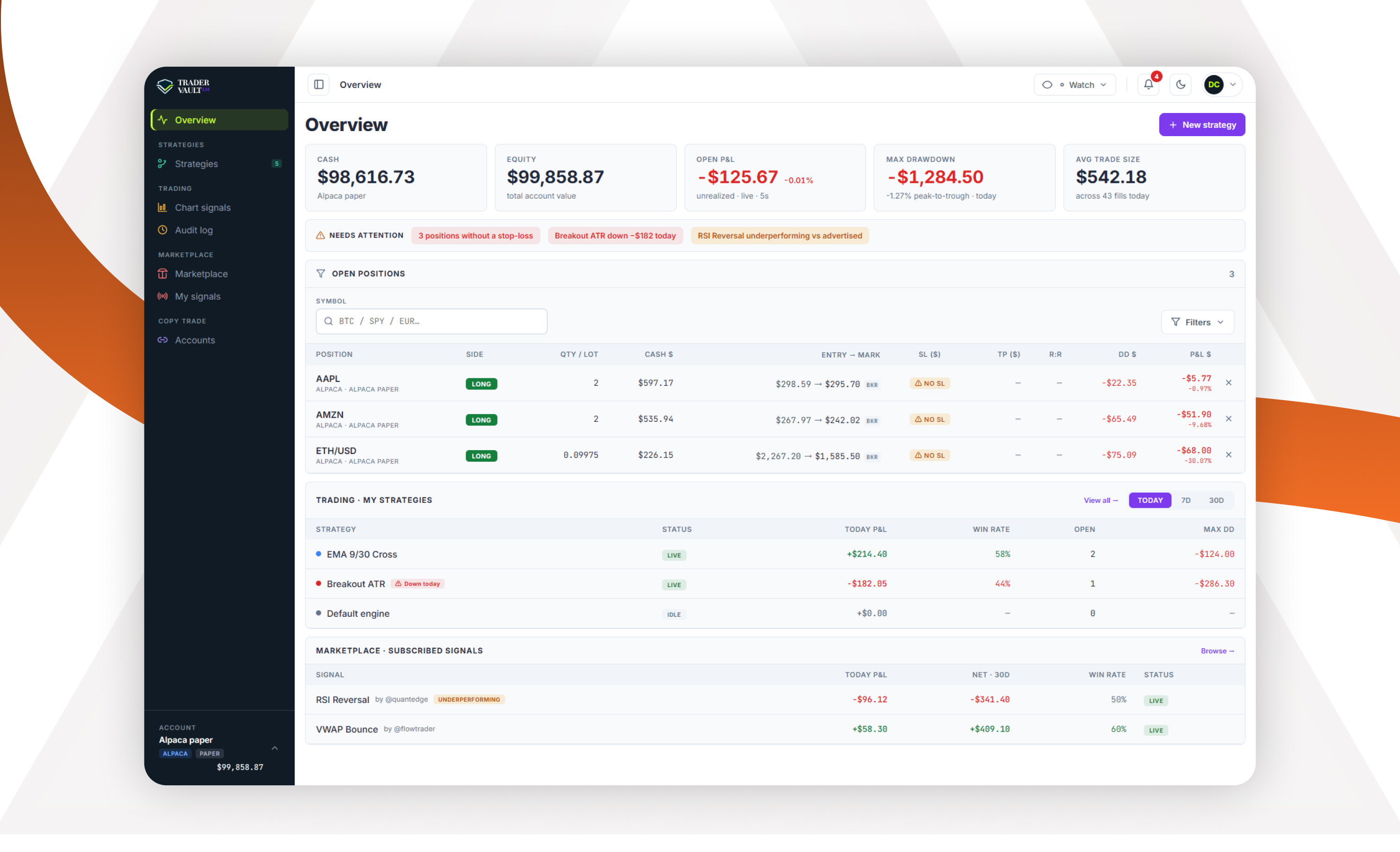
Strategy creation and versioning — the design begins with the trader's daily decision, not a generic analytics dashboard.
The reframe
The question wasn't "how do we show more of the market?" It was: what would the product have to notice, and explain, so the trader sees the right pattern while a decision can still be made?
The product should not make more information visible. It should make the right pattern visible while a decision can still be made.
AI narrows attention and explains context. The trader retains risk ownership and the decision.
A designed handoff
- Observing across signals no one person can watch at once
- Identifying patterns and surfacing setups while they still matter
- Framing probability and explaining context around a setup
- Connecting current decisions to the trader's historical behavior
- Risk judgment and accountability for every position
- Strategy approval and trade selection
- Execution authority — the model interprets, it never executes
- The final decision, with the context to make it well
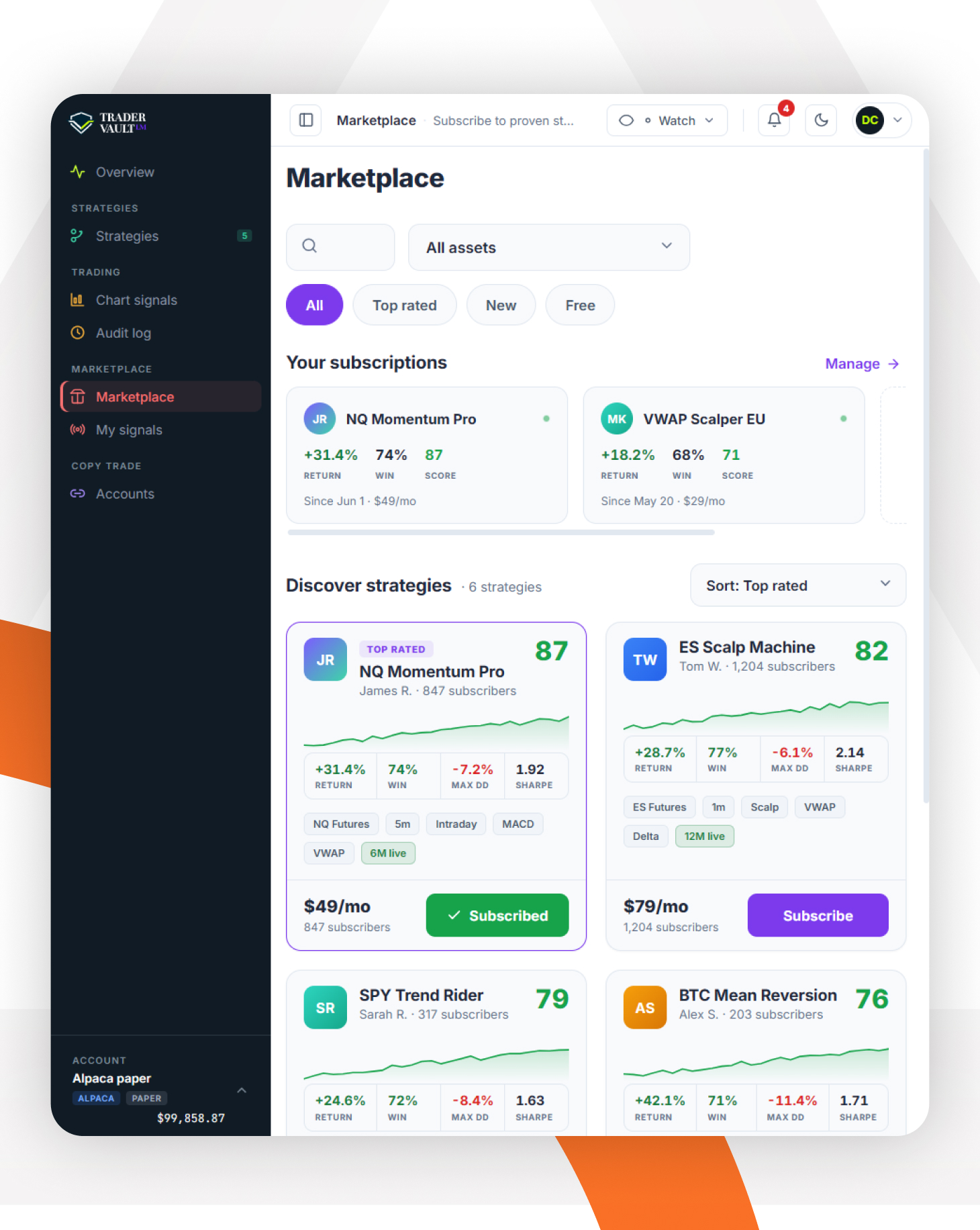
Backtesting and comparison — historical results the language model interprets, so the trader sees what deserves attention instead of another table to decode.
One connected experience
I defined the product concept, strategy and backtesting experience, multi-account and broker workflows, copy-trading model, risk controls, and decision-support UX — informed by more than 25 years of active trading experience, so the design begins with the daily decision rather than a generic analytics dashboard.
Strategy creation and versioning — the trader's rules, kept explicit and revisable.
Historical backtesting and forward testing, connected to the strategy they validate.
Live market signals and broker connections, surfaced while the setup is still tradeable.
Entry, stop, target, break-even, trailing, and partial-profit logic — risk framed before the trade.
Multiple trading accounts and copy-trading controls in the same decision view.
Performance history and journal intelligence — contextual explanations of setups and changing conditions, tied to the trader's own past.
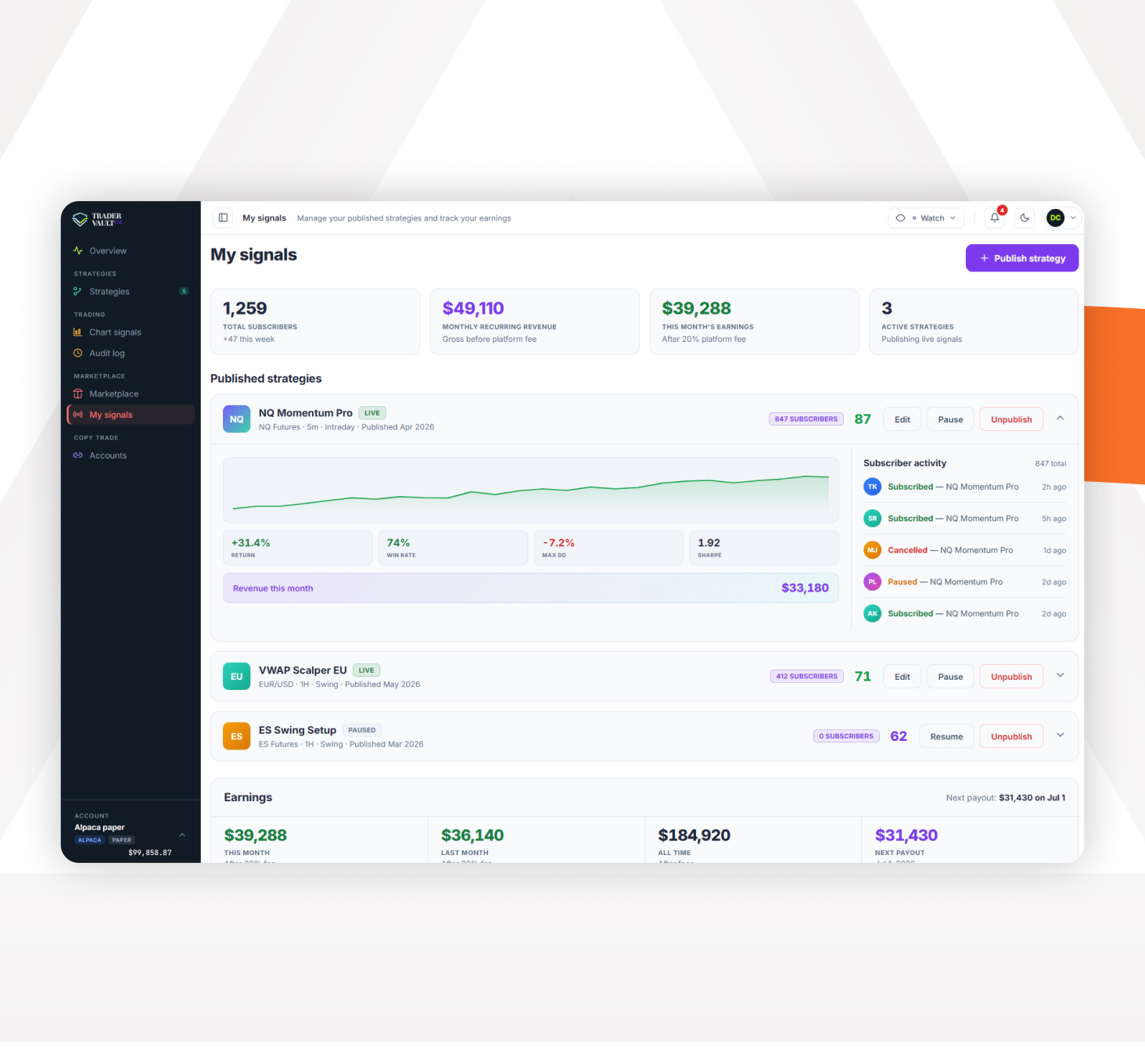
The live setup view — the right pattern made visible while a decision can still be made, with the context that explains it.
The model interprets — it does not decide
The language model is not the mathematical trading engine. Statistical analysis, backtesting, market data, and execution systems produce structured results — AI interprets those results and helps the trader understand what deserves attention. It does not execute live trades.
That separation is the trust model: the system explains the setup, the reason, and the risk — and never pretends to guarantee an outcome.
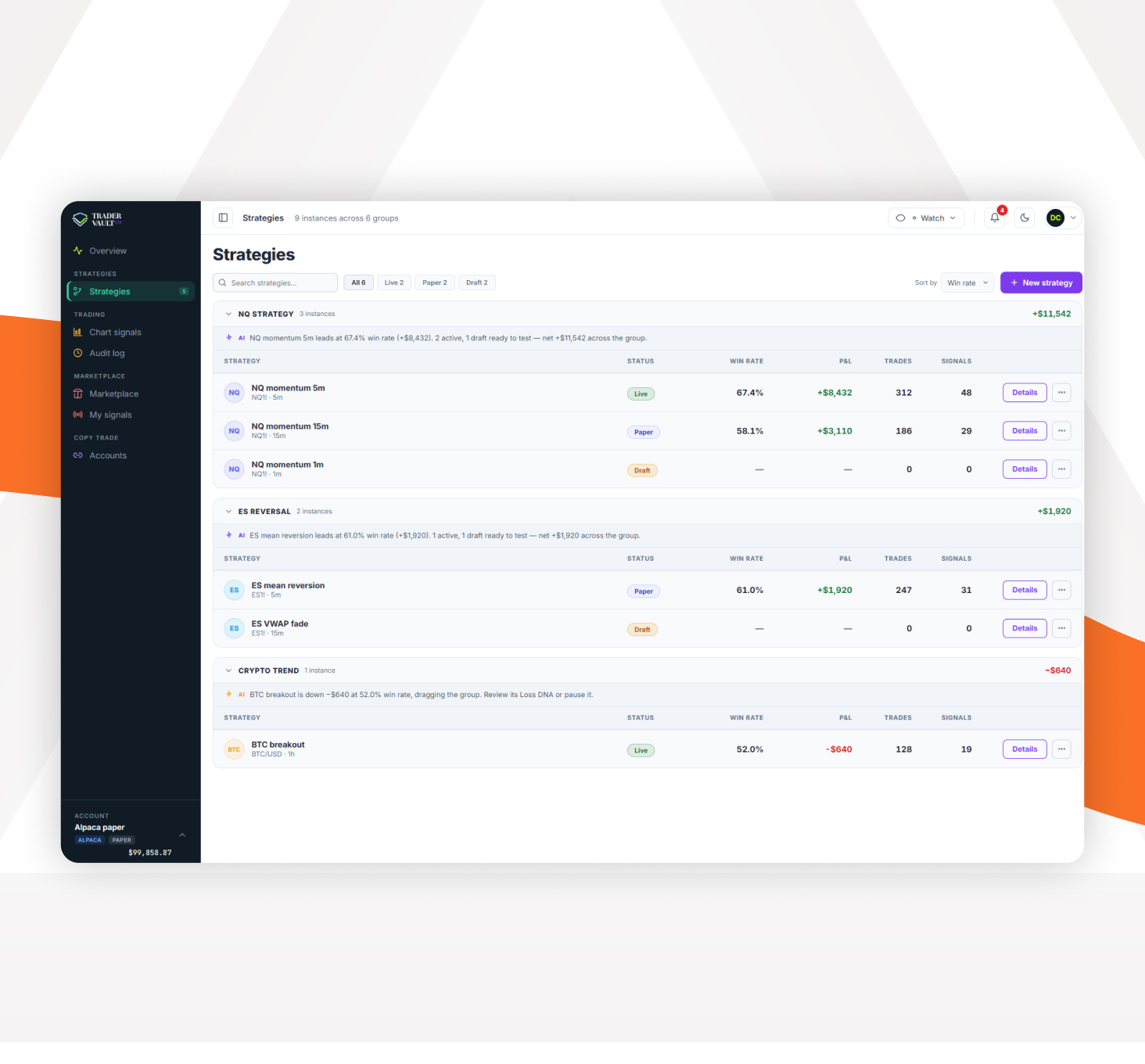
Risk and trade-management controls — entry, stop, target, break-even, trailing, and partial-profit logic, framed before the trade and never presented as certainty.
What changed
TraderVault reframes the trading interface from a collection of charts and data into a decision-support environment. It brings forward the setup, the reason, the risk, and the relevant history — without pretending to guarantee an outcome.
I designed it around a time-sensitive human decision: surface the setup while it still matters, explain the context, connect it to the trader's own history, and keep the final decision with the trader.
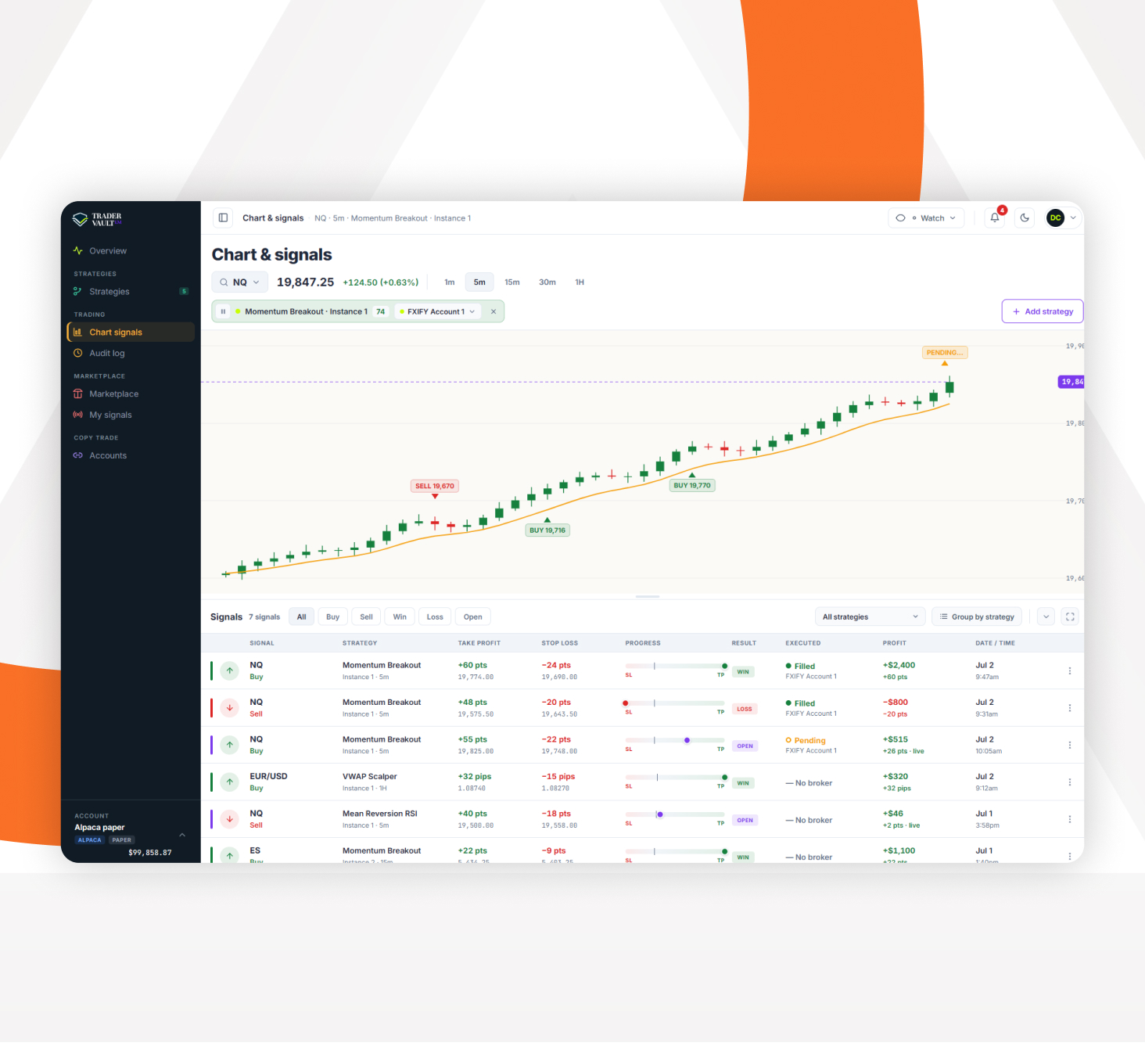
Journal intelligence — performance history and past decisions connected to the current setup, so the journal works as feedback instead of an archive.
What exists today
TraderVault LM is in pre-launch beta. Outcome and retention metrics are not yet available — so this case study makes no claim about guaranteed performance, improved returns, predictive certainty, or mature adoption.
What the beta is designed to prove is narrower: whether a trader, shown the setup with its reason and risk before the moment passes, decides better than with the charts alone.
What this taught me
Narrowing attention is the product. In a high-stakes interface, every extra visible signal has a cost — the design job is deciding what deserves the trader's eyes while the window is open.
Interpretation and machinery are separate jobs. Statistical systems produce structured results; the language model explains them. Keeping those layers distinct is what lets the interface stay honest about what it knows.
A record that never feeds a decision is an archive. Connecting the journal back to the live setup is what turns performance history into something the trader actually uses.
Risk ownership is a design constraint. When the person keeps accountability, the interface must frame probability and risk — and refuse to imply certainty the system doesn't have.
TraderVault LM applies the operating principles behind Seamless Agent OS to a time-sensitive decision: intent guides the work, context persists across the session, the system prepares while the person decides, and uncertainty stays visible. Where Agent OS coordinates a fleet of workers, TraderVault coordinates the signals around one trader — both keep the consequential decision with the human.